

Vicksburg
Essence Is Looking for a Partner. Vicksburg Should Answer.
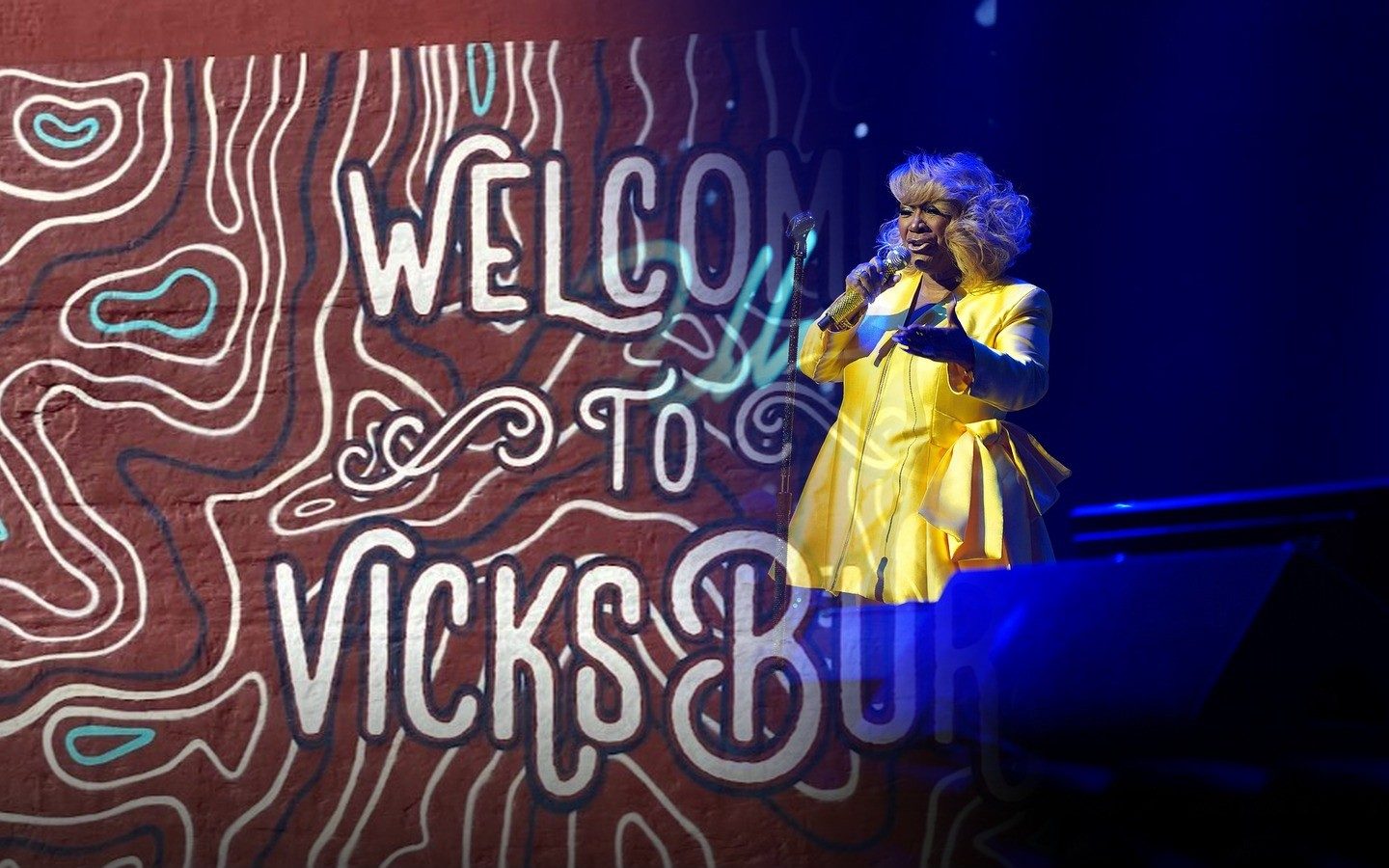
Blend: Cory Seale photo of the downtown Welcome to Vicksburg wall mural; Patti LaBelle at Essence 2026 by HarvestLife, CC BY-SA 4.0
The largest Black festival in America just left New Orleans because it wants a partner committed to its people. No city in America is more rooted in that culture than this one. The honest math says Vicksburg cannot hold the whole festival. The honest answer is to pick up the phone anyway.
The Essence Festival of Culture is leaving New Orleans after more than 30 years. Sundial Media Group, which owns the festival, announced Tuesday that the 2027 festival will not take place in the city where it was born in 1995. The seven-year contract expired in September. Sundial said it sought a multiyear deal for months and the city would not offer one. New Orleans Mayor Helena Moreno said it is time to "go our separate ways."
For anyone who has never been: Essence is not a concert weekend with a festival name. It started in 1995 as Essence magazine's 25th birthday party and never stopped growing. The nights belong to the Superdome, the big stages and the Superlounges. The days belong to the convention center, and they are free: business and money panels, beauty and faith, health, food, and a marketplace of Black-owned brands, all of it built first for Black women. People do not describe going to Essence the way they describe a show. They describe a reunion. Families and friend groups plan their year around it, the way other families plan around a homecoming.
Sundial's statement is the part Vicksburg should read twice. "The largest Black festival of its kind has to be where it can grow, where it is valued, and where it serves the people who make it what it is," the company said. "We need a partner that is committed to that growth and to the people it serves."
Atlanta has reached out. So have Baltimore, Houston, Detroit, Philadelphia, Nashville and New York. Every one of them can outspend Mississippi. None of them can out-story Vicksburg, and none of them is this: a city that is 72% Black, in a county that spends a year courting 400,000 visitors to a battlefield, built on a river bluff where the blues was not imported but born.
Willie Dixon, who wrote the Chicago blues songbook, was born at 1631 Crawford St. in 1915. Six Mississippi Blues Trail markers stand in this city, more than almost anywhere: the Blue Room on Clay Street, where Tom Wince brought B.B. King, Ray Charles, Fats Domino, Louis Armstrong and Dinah Washington to a Black room in a segregated city; Marcus Bottom, which once held the largest Black community in Mississippi; the Red Tops; Highway 61 itself. Bethel A.M.E., founded in 1864, was the first A.M.E. church in Mississippi. W.H. Jefferson Funeral Home, founded in 1894, is the oldest Black-owned business in the state. Alcorn State is 40 miles away. Jackson State is 40 miles away. Essence's own audience, 82% Black women spending an average of $3,135 a trip in the festival's 2024 profile, is not an audience Vicksburg would have to introduce itself to. It is the family.
And the festival's heart is not only the concerts. Its marketplace put more than 200 Black-owned brands in front of those audiences in 2025. That is the part of Essence built for a city of Black-owned businesses, and it is the part Vicksburg should be asking for by name.
Now the math, because a pitch built on pretending is a pitch that dies in the first meeting. Essence averaged about 88,000 people a day in 2026. Vicksburg's entire population is about 21,500. New Orleans holds the festival in a 73,000-seat Superdome and a convention center with 1.1 million square feet of exhibit space, in a city with more than 26,000 hotel rooms. Vicksburg has about 2,000 hotel rooms, a convention center of about 50,000 square feet and no stadium. The festival generated $321.9 million in economic impact in 2025, and Sundial went looking for $10 million to $12 million a year in public support. New Orleans gave about $750,000. Louisiana, which once gave up to $2 million, gave nothing this year. Mississippi's festival grant program caps at $10,000. Vicksburg cannot host the 2027 Essence Festival, and it cannot buy its way into the conversation. Anyone who tells you otherwise is selling something.
What Vicksburg can do is be the partner Sundial described, at a scale that is real. Warren County already runs its tourism through a city-county convention and visitors bureau funded by a food and lodging tax, governed by a board the city and county appoint together. The city and county just agreed to co-finance a $114 million visitor center project at the military park, up to $15.5 million local over 30 years, inside a year when the state put more than $47 million into Vicksburg tourism ground. The partnership machinery exists. It has simply never been aimed at the Black culture that built this city.
So aim it. Ask Sundial for a piece of Essence sized for this city: the marketplace of Black-owned brands, a heritage weekend on the riverfront and in the Convention Center, blues in the rooms where the blues actually happened, with Jackson, 45 minutes away with the stadium, the airport and the Amtrak station, as the scale partner for anything bigger. Guarantee in writing the thing New Orleans is accused of failing at: vendors paid, in full, on time. Moreno is building her replacement festival on exactly that promise, and she announces it Dec. 9. The lesson of this divorce is not that festivals are faithless. It is that cities that treat Black culture as a tenant lose it, and cities that treat it as a partner keep it.
The risks are real and belong in the open. A courtship costs staff time and credibility if it is done as a stunt. A scaled event still strains rooms, roads and public safety, and its bills land on the same taxpayers the grocery tax already squeezes. The festival leaves New Orleans under a vendor-payment cloud, with the convention center there reportedly owed about $400,000 from 2025; Sundial says more than 90% of vendors are paid and every vendor will be. Any Vicksburg deal has to be papered so this city's small Black-owned vendors are never the ones holding the bag. And the Census cannot even say how many Black-owned businesses Warren County has; the figure is suppressed, uncounted. A city that wants to pitch itself as the home of Black enterprise should start by counting its own.
None of that is a reason to sit out. It is the agenda for the first meeting. The window is open this week, while Sundial is taking calls and before a bigger city closes it. Vicksburg has spent 2026 proving it can fill Washington Street for free concerts, art and porches. This is the same instinct at a higher stake: the culture is already here, the people are already here, and for once the invitation is public. Essence said it needs a partner committed to the people it serves. There is a city on the river where those people are the majority, the history and the future. Somebody from Vicksburg should say so, out loud, before Dec. 9.
Source: HuffPost and Essence ROI reporting
See this story on Facebook: Vicksburg Today